

Healthcare branding isn’t about flashy logos or catchy taglines but about trust. It’s how patients perceive your facility, your team, and the level of care you deliver. In an industry where lives are at stake, and every interaction matters, your brand needs to do more than show up; it needs to stand out and stand for something.
A strong healthcare brand strategy positions your organization as a leader. It cuts through the noise, attracts the right patients, and builds lasting credibility in a saturated market. But to get there, you need more than good intentions; you need a strategy that’s consistent, intentional, and built for long-term impact.
Building a Brand
Building a brand doesn’t happen overnight. It takes consistent action over time, and in healthcare, that consistency directly impacts patient trust and loyalty.
If your team can’t fully commit the time and resources required to execute a branding strategy that actually works, it might be time to consider partnering with an experienced marketing agency. But if you’re ready to take control and do it in-house, the strategies below will help guide your approach.
Create a Patient-Centric Experience
A healthcare brand is defined by how patients experience it. If patients feel valued, understood, and cared for, that becomes your brand. So the first step is understanding where your patient experience stands today, and where it needs to improve.
Start by reviewing patient feedback. Dive into online reviews and collect insights through surveys. If you’re consistently seeing complaints about the billing process or online scheduling, that’s a brand issue. Address it.
Maybe your clinic is stretched thin with long wait times. Would reducing volume and positioning your clinic as more exclusive improve patient satisfaction? These kinds of decisions can feel risky in the short term, but they often pay off in long-term brand loyalty.
A great healthcare brand strategy often involves short-term sacrifice for long-term gain. Look at Amazon: their one- and two-day shipping policies cost them at first, but they built one of the most trusted consumer brands in the world as a result.
What issues are you currently avoiding because of temporary inconvenience? Bring them to the table. Branding is a long game, and patient trust is the prize.
Create a Marketing Engine
Now that you are executing a game plan to fix these issues and elevate your customer experience, scaling your healthcare branding requires a strong marketing engine.
So how do you build a strong marketing engine?
If you want to implement a marketing strategy yourself, we’ll discuss (in great detail) how we recommend planning and executing a strategy.
If you prefer a done-for-you solution to your healthcare brand strategy, you can also hire a marketing partner.
SEO
SEO is the foundation of your digital marketing strategy, and by extension, your branding. If your site isn’t visible on search engines, potential patients won’t find you. And if they do land on your site and the experience is clunky or unclear, they won’t convert.
Start with the basics:
- Make sure your site architecture is clean and intuitive.
- Build out individual service pages with in-depth, patient-focused content.
- Create high-quality, relevant blog content and interlink it properly.
- Build backlinks from trustworthy sources.
This isn’t just an SEO checklist but also how you demonstrate authority and earn trust. Strong rankings don’t just bring traffic. They bring the right traffic. And that leads to real conversions, not just clicks. Let’s dive into each one in a little more detail.
Analyze Your Site Architecture
Your user should be able to get to each page on your website in three clicks or less. Ideally, if it’s a key page (such as a services page), they should be able to access it in just one click.
For example, this website has excellent architecture. While they have many pages, it’s easy to find exactly what you’re looking for just by viewing the menu.
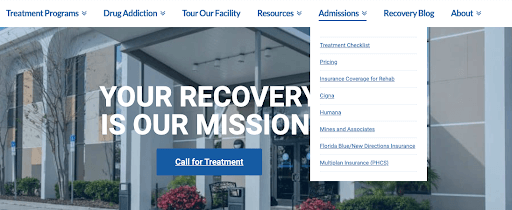
So, in short, your website’s architecture should look like this:

Rather than this:
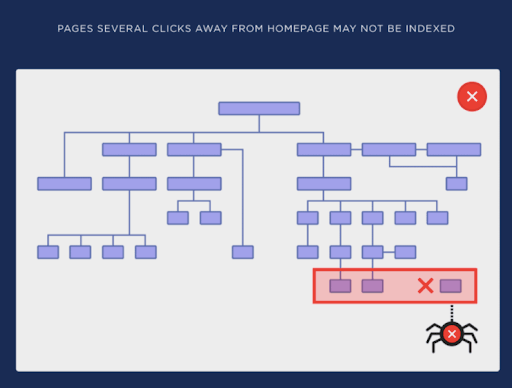
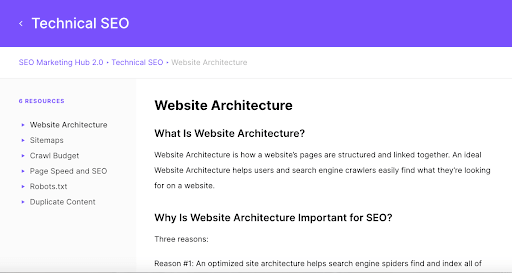
This also applies to your content. For example, creating topic clusters (chaptered guides around a particular topic) is a great way to rank for difficult head terms.
Brian Dean of Backlinko did an excellent job of creating a topic cluster for all of his content on technical SEO.
Build Out Your Services Pages
Service pages are the most valuable real estate on your website. They’re where patients decide whether or not to take the next step. If these pages don’t clearly communicate your expertise, answer common questions, and guide users toward action, you’re leaving opportunities on the table.
Dig into patient calls and inquiries. What questions come up most often? If those questions aren’t answered directly on the corresponding service page, fix that.
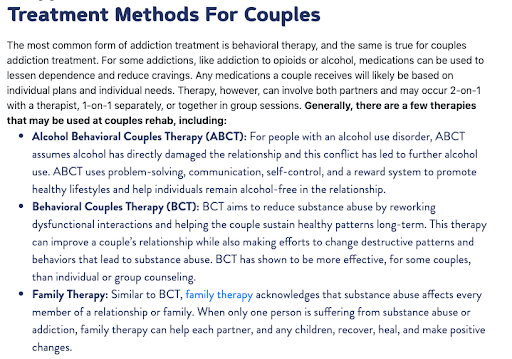
Example: This page performs well for high-intent search terms like “couples addiction treatment” work because they’re comprehensive. They answer questions patients are already asking, such as techniques, suitability, timelines, and costs.
To go even further, consider adding anonymized patient stories or embedded FAQs. This builds both trust and conversion power.
Build Quality Links to Those Key Pages
Once you have optimized your key pages, build links to them! While there has been a lot of debate about the future of link building and its importance, it remains a key factor Google uses to determine your page’s authority.
The number of links pointing towards your page may not matter as much. However, a few high-quality links will still positively impact your rankings.
So how can you generate a few high-quality links?
One way is to be active in your community and work with partners. For example, if you donate to a local charity or event, ask them to provide a link back to that services page. You could also be a resource for an educational institution. This can include a school or college for example. This will help provide you with more high-quality links.
This is how Google intended link building to work. Essentially, the most trusted brand within the community should rank. So, rather than trying to manipulate Google’s system, just think about building your healthcare branding and ask everyone you create a genuine partnership with to send a link.
Other link-building tactics can work, though my favorite is guest posting. Here, you can create a genuine relationship with that website.
Another method is to scan through all of the websites linking to your competitor’s service pages. Then you can reach out to them for a link as well.
To do this, just log in to Ahrefs, enter the competitor’s service page URL, and look at the websites linking to it.

Create a Blog, Post Quality Content Regularly, and Internally Link
Finally, post quality content regularly.
While this may sound like an insignificant aspect, it’s really the bulk of your SEO strategy, as people only come to your website if you have content that answers the questions they type into Google.
However, the biggest question is: What should you write about?
Ideally, write about topics that your potential customers are searching for. For example, if you’re an addiction center, writing about a celebrity with addiction will likely generate a lot of traffic, though it won’t generate any relevant traffic.
Most people Googling about that celebrity’s addiction are probably just fans of that celebrity rather than people struggling with addiction themselves.
Similarly, writing posts about which drugs are most addictive or the current opioid crisis likely won’t generate qualified traffic. These people are likely just curious rather than those with a current addiction problem.
Instead, create content for keywords like:
- How effective is addiction recovery?
- How to help an addicted loved one
- Most effective addiction treatments
Notice that people searching for these terms are much more likely to make a purchase?
If you’re having trouble generating ideal keyword topics, ask your sales team what questions patients commonly ask or the most common qualifiers (for example, couples, women, or men).
Once you have an excellent topic, be sure to address it fully. For example, Google that keyword and look at the top-ranking results. If they are addressing more points within their content than you are, you probably won’t be able to rank. This is true even if you have more links.
While you won’t see your SEO strategy produce results overnight, it is an excellent place to start. The results will compound over time and make your other campaigns more effective.
PPC
Now that you have an excellent baseline to build your healthcare marketing and branding strategy, use PPC (Twitter ads, Facebook ads, or Google ads) to start generating some immediate results.
Typically, most websites begin with conversion-focused keywords to generate the biggest ROI in the shortest amount of time. However, if you already have a steady patient stream and your main goal is to generate brand awareness, you may want to run ads to your content.
Not only is it typically cheaper to run ads to your content, but it is also a great way to get them acquainted with your healthcare branding and build trust to eventually soft sell them.
Email Marketing
Email marketing remains one of the most powerful and often underused tools in healthcare brand strategy.
Unlike cold traffic, email subscribers already know who you are. They’ve shown interest, have a relevant pain point, and are much closer to taking action. That makes email one of the highest-ROI channels available. In fact, HubSpot reports that email marketing can deliver up to $42 in return for every $1 spent.
Despite its potential, most healthcare organizations treat email as an afterthought, sending generic updates about physicians, events, or internal news. That’s not branding. That’s noise.
Effective email marketing requires more than updates. It requires a connection. Every email should reflect a clear understanding of the patient journey, speak to real concerns, and offer genuine value. Whether it’s through patient success stories, helpful guides, or Q&A interviews with clinicians, the goal is to build trust and stay top of mind.
Great examples exist outside of healthcare. For instance, entrepreneur Ramit Sethi has built an email strategy that drives the majority of his revenue. His emails are personal, pain-point driven, and surprisingly engaging, proof that when done right, email can carry an entire brand.
Healthcare providers can apply the same principles. With the right strategy, tone, and cadence, email becomes more than a follow-up tool; it becomes a brand-building engine.
Connect With Patients Through Email
Though the healthcare industry is different, is there a way to connect with your patients on a deeper level through email? Building a strong brand is all about creating something that people feel connected to. So, how can you better resonate with your audience?
That may be sharing patient stories or informative (yet entertaining) interviews with doctors.
While it may take some time to find the right format that resonates with your audience, track your subscription rate, bounce rate, and click-through rate. Ideally, you want an open rate of 15-25%. However, if you make them more personalized, you can probably get an even higher open rate.
Your click-through rate will depend largely on your offer and how warm the audience is, so be careful not to sell too much in each email. A good cadence is roughly one sell for every 3-4 emails.
If your emails still aren’t doing well, you can always ask a professional email copywriter to look at them for you.
Social Media
In today’s landscape, a strong social media presence is a pillar of strong healthcare branding.
Social is not just a promotional channel; it’s a trust-building tool. Unlike search engines, social media users aren’t necessarily looking for solutions; they’re looking to connect. So meet them there with stories that stick.
Focus on real patient experiences, behind-the-scenes moments, or educational content delivered engagingly. You don’t need a massive production budget to create impact. A well-told patient story and a single compelling image can go a long way.
And remember that engagement is more valuable than vanity metrics. If your content is getting shared, commented on, and saved, you’re on the right track.
Monitor and Test
Your marketing engine is up and running, and patients love the customer experience.
Now the challenge is to monitor your growth and ensure that you can handle the influx of patients. Therefore, actively watch your reviews and notice if any other complaints crop up. You should also keep an open line of communication with receptionists and doctors, as they will be the first to hear patient complaints.
If you hear that the demand is too much for doctors and nurses, limit the patients you accept to maintain high quality. The most important aspect of building a brand is satisfying your patients, so make that a priority in the business.
In addition to monitoring patient happiness, monitor your analytics weekly. Are the changes causing engagement to increase or decrease? Are you bringing more qualified patients or fewer? How do your patients view your brand? You can do sentiment analysis with a feedback tool like Qwary for this.
Improving your healthcare brand strategy requires tests, though not every test will be better than the last one. However, if you watch your analytics weekly, you’ll find that over time, your tests continue to elevate your brand’s status and hopefully grow the brand to be an industry leader.

Examples of Strong Branding in Healthcare
Executing the healthcare branding strategies above lays a solid foundation for long-term growth. To illustrate what effective branding looks like in action, here are a few standout examples from organizations that have built trusted, recognizable brands in the healthcare space.
Mayo Clinic
The Mayo Clinic truly understands what it means to be a brand. Whenever you search for something health-related, you probably see their articles in the search results, click on them, and feel confident that you are reading accurate medical information.
This is because they have established an omnipresent brand that has consistently produced accurate information for many years. There really isn’t anything special about what they have done other than maintaining unwavering consistency with their messaging and brand image.
Even if you don’t have the bandwidth to write content for every healthcare topic under the sun, think about how you can be omnipresent and create content for every condition you treat.
New York Presbyterian
The New York-Presbyterian Hospital has a similarly strong brand as the Mayo Clinic. However, rather than building their presence through SEO, they’ve leveraged social media to share captivating stories that patients and other followers are happy to share.
These stories are not only emotional and noteworthy, but they also subtly show off the expertise of the New York-Presbyterian Hospital’s talented staff.
Fortunately, you don’t have to have thousands of dollars to create social posts like this. Instead, ask doctors what some of the most heartwarming stories they have come across are. Then write patient stories with a simple image (which they can submit). If you have a little more money to invest, you can also create a video of the story.
7 Summit Pathways
Even though there are ways to duplicate what NYP and Mayo Clinic are doing on a smaller scale, you may want a more niche brand to emulate. Therefore, 7 Summit Pathways is an excellent example.
They rank for plenty of important purchase intent keywords and are a leader in the addiction treatment industry.
In fact, they earn about 15,000 visitors to their site monthly and own over 16,000 keywords.
They also have excellent reviews. This isn’t always common, as addiction treatment isn’t always successful. They are clearly delivering a wonderful patient experience.
Therefore, if you are a small brand, emulate 7 Summit Pathways by consistently producing high-quality content in your niche. Also, provide the best patient experience possible.
Healthcare Branding That Earns Trust and Converts
If you don’t have the capacity to consistently produce content and promote your message, consider hiring an agency. Find the right agency that is experienced in healthcare branding and can automate these tasks for you.
Stodzy Internet Marketing has helped some of the largest recovery centers and other healthcare companies improve their brand presence and become recognized as international leaders.
Contact us today for a free consultation and learn more about how we can help improve your brand presence.